

Chloryllfid
| |||||||||||||||||||||||||||||||||||||||||||||||||||||||||||||||||||||||||||||||||||||||||
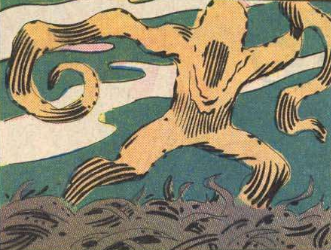
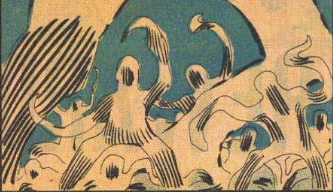
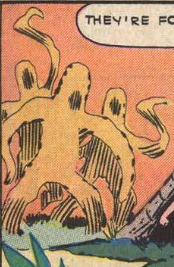
The Chloryllfids are kelp mutants who debuted in issue #16 of Charlton Comics' Gorgo comic series.
Name
The Chloryllfids' name likely stems from chlorophyll, green pigments found in plants that give them their green color and allow them to convert sunlight to energy. It may also draw inspiration from the Triffid, a species of mobile man-eating plant featured in the 1951 science fiction novel The Day of the Triffids by John Wyndham. In-universe, they were named by the marine biologist Peter Carewe, who created small versions of them in his laboratory.
Personality
The Chloryllfids show no sign of a sentient personality; they move with a voracious hunger for everything. They are also extremely aggressive, attacking and killing anything that approaches them. They only show signs of sentience when they need to release their seeds into the ocean to reproduce.
Design
The Chloryllfids are humanoid plants that bear no resemblance to normal plants. They are yellow in color with black stripes on some parts of their bodies. Four tentacles are visible on the body: two as arms and two as legs, which can be stretched along with the body. They have a face with no eyes, although they appear to have a facial structure that could accommodate them, as well as a circular mouth with some type of plant matter underneath it. On the cover of the comic, a Chloryllfid is shown with a salmon-colored body.
Origins
The Chloryllfids were born from kelp exposed to gamma radiation. Marine biologist Peter Carewe accidentally produced a group of smaller forms during an experiment in which he exposed a tank containing marine plants to gamma radiation. A larger variety were produced during an atomic bomb test on the Pacific Ocean floor, which mutated a kelp bed.
History
- Gorgo #16 (1963)
Gorgo
Issue #16
During a routine test in the Pacific Ocean, a plane dropped an atomic bomb, which detonated deep in the ocean. On the ocean floor, a huge kelp bed—exposed to the radiation from the atomic bomb's detonation—began to mutate and grow at an alarming rate, breaking free of its roots, forming into a collection of Chloryllfids that began walking across the ocean floor.
The Chloryllphids traveled to an island in the South Pacific, where they were sighted by the native people of the island, who ran from them. Dr. Aldous Maltby, a missionary, and his daughter, Karen, witnessed the natives fleeing from something. One of them, Koola, warned Dr. Aldous that plant monsters had surfaced from the ocean around the island, informing him that he and the rest of the native people were evacuating the island and urging him and his daughter to do the same. Dr. Aldous was incredulous of Koola's story but wanted to find out what frightened the island's people enough that they would evacuate, so the father and daughter then went to investigate what they had seen. They encountered a jaguar that was ready to attack them, but before it could do anything, one of the Chloryllfids appeared and subdued the animal. More of the Chloryllfids appeared and started sucking the jaguar, leaving Karen and Dr. Aldous terrified by what they had seen. The Chloryllfids then sighted the two humans, who fled to the plane and left the plants on the island.
Once they arrived in the United States, Dr. Aldous began to recount what they had seen, but many people rejected his account. They went to a local scientist club, thinking the scientists would be more receptive to their story; however, most of the scientists scoffed at his story except Peter Carewe, a marine biologist. He led Dr. Aldous and Karen into his laboratory, where he was conducting an experiment involving exposing jellyfish to gamma rays. The jellyfish did mutate, as did the plants, the latter of which ate all the other fauna in the tank. When Peter showed Dr. Aldous and his daughter the creatures, which he had named Chloryllfids, they were shocked. Peter then stated that, thankfully, they were small, but they had eaten all the jellyfish in the tank and survived his attempts to kill them. Dr. Aldous said that the ones he and his daughter saw on the island were huge, and Peter asked him to point out where he had seen them. Recognizing the island Dr. Aldous identified was in proximity of an atomic bomb test, Peter postulated that the Chloryllfids on the island reached larger sizes than the ones he created due to higher exposure to gamma radiation. After discussing the matter in the lab, the three of them traveled to the island, where they saw dead animals such as snakes and crocodiles, with only their skin remaining. After roaming the island for an hour, they had not encountered any Chloryllfids, so Peter suggested they wait for them to come, as the Chloryllfids would not come if they kept searching. On the ocean floor, the first Chloryllfid, which was not fully mature, returned to the kelp bed and began releasing its seeds. The seeds rapidly grew into more Chloryllfids, which swam to the surface after sensing life near the island. When the creatures surfaced, Aldous, Karen, and Peter heard the creatures and prepared their flamethrowers. When the creatures attacked, one grabbed and wrapped Karen in its tentacle until Peter came and cut it off, saving Karen. The Chloryllfids surrounded the trio, preparing to kill them; however, Gorgo and his mother arrived on the island and started eating all of the Chloryllfids, saving the trio. Once the monsters devoured all of the Chloryllfids, the trio returned to their plane, leaving Gorgo and his mother to digest the Chloryllfids seedlings under the sea.
Abilities
Physical abilities
The Chloryllfids can use their tentacles to wrap around their enemies, as one of them did with Karen. Chloryllfids can stretch their bodies for swimming or attacking, as they did when they attacked the main characters.
Rapid growth
Due to their mutation, the Chloryllfids can grow quickly. This ability was demonstrated when they were first affected by the atomic explosion and later when the giant Chloryllfid dropped the seeds.
Reproduction
Chloryllfids reproduce by dropping seeds into the kelp bed. Because of their mutation, new Chloryllfids are generated. They can also spread their seeds to create more Chloryllfids.
Absorption
The most notable ability of the Chloryllfids is that they can absorb everything from inside the body of their victim, leaving only the skin. They have done this to jaguars, crocodiles, and snakes.
Amphibiousness
Chloryllfids are mostly aquatic, although they can walk on land. Primarily, they go into the sea to reproduce.
Durability
Although they seem fragile, Peter Carewe was unable to kill the small Chloryllfids he had created, despite using everything he had. They are also resistant to flamethrowers; none of the characters who battled them were harmed by the weapons.
Weaknesses
Despite their great durability, they eventually perish when consumed by Gorgo and Ogra.
References
This is a list of references for Chloryllfid. These citations are used to identify the reliable sources on which this article is based. These references appear inside articles in the form of superscript numbers, which look like this: [1]
Comments
Showing 8 comments. When commenting, please remain respectful of other users, stay on topic, and avoid role-playing and excessive punctuation. Comments which violate these guidelines may be removed by administrators.

|

|